(fr) Mon exploration d’une impression de chariot de magasinage en niveaux de gris m’a amené à créer une intervention dans l’espace public sur le mur du Wendling Estate à Londres, transformant un objet de la classe ouvrière en quelque chose d’important. La consultation de la communauté a été au cœur de ce projet. Elle a permis de s’assurer de l’engagement et du soutien des résidents, ce qui a contribué à instaurer une culture de coopération entre eux. Grâce à l’engagement social et au consentement de la communauté, ce projet reflétait le pouvoir de l’art de favoriser les liens et la représentation dans les espaces marginalisés. La même gravure a ensuite été retrouvée à Paris, renforçant l’expérience partagée dans les quartiers populaires.
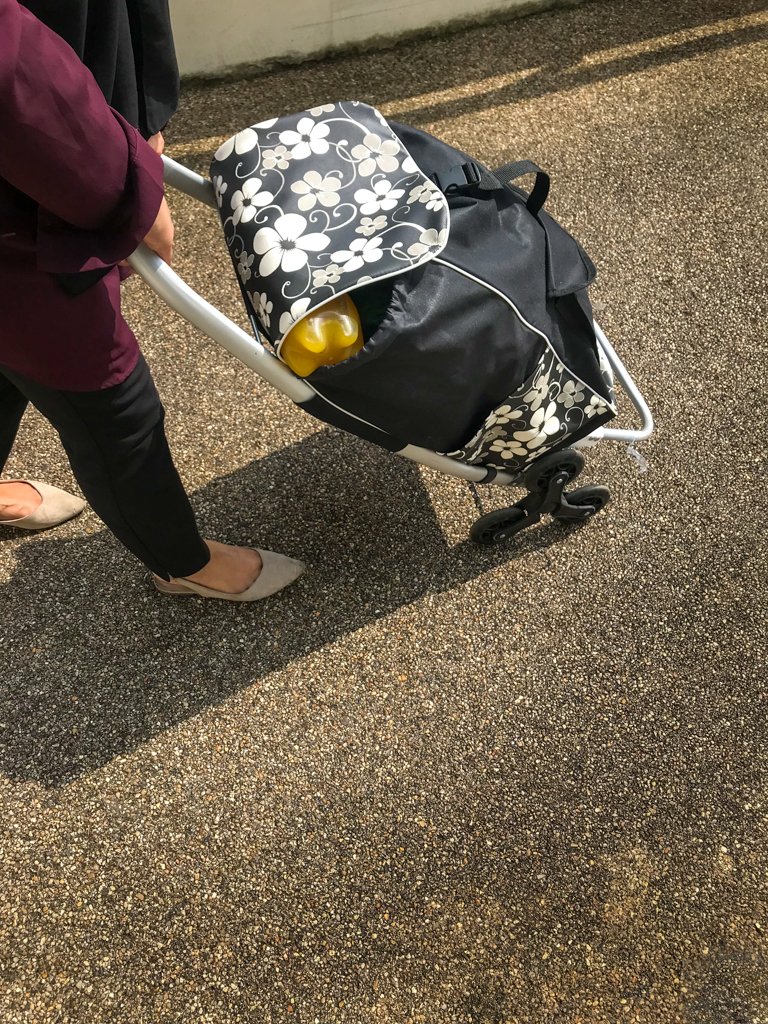
(en) My exploration of a greyscale shopping trolley print led me to create an intervention in public space on the wall of the Wendling Estate in London, transforming a working-class object into something of significance. Central to this project was community consultation, ensuring that residents were engaged and supportive, which helped build a culture of cooperation among them. Through social engagement and community consent, this project reflected the power of art to foster connection and representation in marginalised spaces. The same print was later found in Paris, reinforcing the shared experience across working-class neighbourhoods.
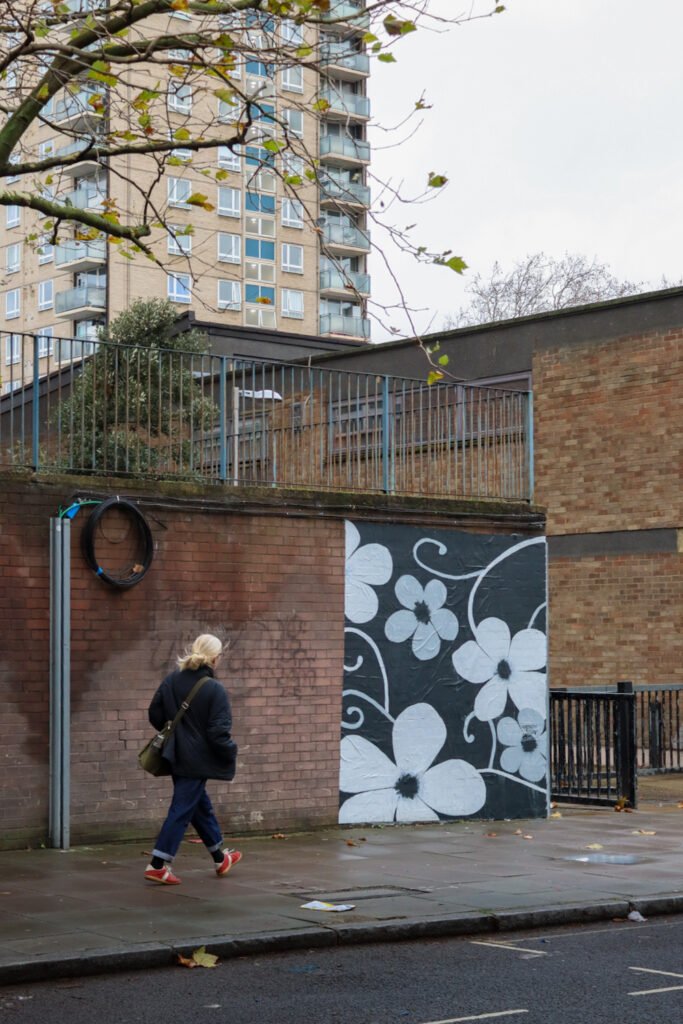
(fr) J’ai été fasciné par une impression en niveaux de gris, semblable à celle de Warhol, qui ornait le caddie d’une femme vivant dans le quartier de Wendling Estate à Gospel Oak, à Londres. Captivée par sa résonance visuelle, j’ai peint une reproduction grand format que j’ai collée sur un mur de la cité, un acte qui mêle l’art public à la vie quotidienne. Avant d’entreprendre ce projet, j’ai mené une enquête auprès des habitants de la cité pour m’assurer d’un consensus. Tous les résidents, à l’exception d’un seul, ont approuvé le projet. L’unique dissident, qui semblait passer une journée difficile, a lancé un flot d’accusations, mettant en doute mes motivations et interprétant cyniquement le geste comme étant intéressé. Son hostilité a fait de moi la cible de ses frustrations cet après-midi-là. Toutefois, il s’est avéré par la suite qu’elle rendait simplement visite à sa mère et qu’elle ne résidait pas dans la propriété. Avec le soutien massif des résidents actuels, j’ai poursuivi mon travail.
(en) I became fascinated by a greyscale, Warhol-esque print that adorned the shopping trolley of a woman living on the Wendling Estate in Gospel Oak, London. Captivated by its visual resonance, I painted a large-format reproduction and pasted it onto a wall within the estate—an act that intertwined public art with everyday life. Before undertaking this project, I conducted a survey among the estate’s residents to ensure consensus. All but one resident approved. The sole dissenter, seemingly having a difficult day, unleashed a barrage of accusations, questioning my motives and cynically interpreting the gesture as self-serving. Her hostility made me the target of her frustrations that afternoon. However, it later emerged that she was merely visiting her mother and did not reside in the estate. With the overwhelming support of the actual residents, I proceeded with the work.
(fr) En utilisant du papier brun comme toile, j’ai méticuleusement reproduit l’impression du sac à roulettes et je l’ai apposée sur le mur désigné. Alors que je l’installais, une femme qui vivait juste en face de l’œuvre s’est approchée de moi et, à ma grande surprise, m’a offert de l’argent en remerciement de l’œuvre. J’ai décliné son offre généreuse, mais je me suis demandé plus tard si je n’aurais pas dû au moins lui demander combien elle avait en tête.
(en) Using brown paper as my canvas, I meticulously replicated the trolley bag print and affixed it to the designated wall. As I was installing it, a woman who lived directly opposite the artwork approached me and, to my surprise, offered me money in appreciation of the piece. I declined her generous offer but later wondered whether I should have at least asked how much she had in mind.
(fr) Une attaque au sein de la communauté a eu lieu sur le site de l’œuvre – une colère qui n’aurait peut-être jamais surgi si davantage de consultations artistiques communautaires avaient été organisées. Dans un scénario idéal, le second rôle de l’artiste public est celui d’un agent de médiation et de proximité. On peut soutenir, à partir de la valeur du travail accompli dans ce type de projets, que la meilleure défense d’une communauté contre la logique lucrative du développement immobilier réside dans la consultation : une pratique fondamentale permettant aux jeunes, ainsi qu’aux nouveaux habitants comme aux résidents de longue date, de s’associer, de délibérer et de s’intégrer, afin de fonctionner comme un corps collectif résilient, moins vulnérable aux formes mineures de contagion antisociale. De la même manière qu’une vaccination protège contre la maladie, la consultation communautaire — à travers la question apparemment triviale de l’art public — peut offrir une forme d’immunité, en introduisant, idéalement, des interventions artistiques éphémères dans le tissu social.
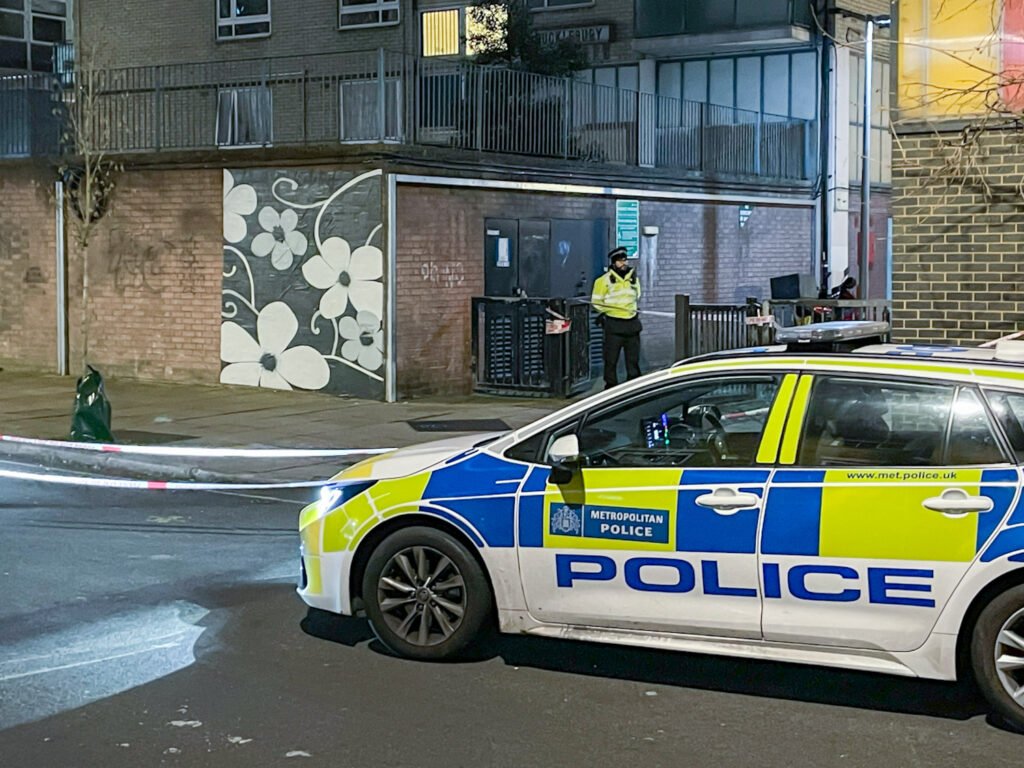
(en) An attack within the community took place at the work site – anger that might never have arisen had more community arts consultations been organised. In the ideal scenario, the public artist’s second role is that of a community outreach worker. It can be argued, based on the valuable work of such projects, that a community’s best defence against the profit-driven logic of real estate development lies in consultation: a grounding practice through which young people, as well as new and long-standing inhabitants, can associate, deliberate, and integrate, functioning as a single resilient body, less vulnerable to minor forms of antisocial contagion. In the same way that vaccination protects against disease, community consultation—through the seemingly trivial matter of public art—can provide a form of immunity, by introducing ephemeral artistic interventions into the social fabric.
(fr) Peu de temps après, dans le quartier animé de Barbès à Paris, j’ai retrouvé la même impression textile de chariot de magasinage, cette fois dans les mains d’un homme naviguant dans les rues animées. Intrigué par cette récurrence inattendue, je l’ai suivi discrètement et j’ai filmé son caddie remontant le boulevard Barbès en direction de la station de métro Château Rouge, un quartier connu sous le nom de « Petite Afrique ». Cette observation fortuite a renforcé la présence internationale de l’imprimé – deux personnes, deux villes, le même motif traversant des quartiers populaires.

(en) Not long after, in the vibrant Barbès district of Paris, I encountered the same shopping trolley print once again—this time in the hands of a man navigating the bustling streets. Intrigued by this unexpected recurrence, I discreetly followed him, capturing footage as his trolley wound its way up Boulevard Barbès towards Château Rouge metro station, an area known as Little Africa. This chance sighting reinforced the print’s international presence—two people, two cities, the same design traversing working-class neighbourhoods.
(fr) Après avoir installé le tableau à Gospel Oak, je me suis rendu en Sicile pour un court séjour, dans l’intention de rencontrer Julian, que j’avais déjà rencontré à Cadix. Pendant mon séjour, je suis tombé sur le livre Warhol : L’arte di essere famosi, publié par la Rosini Gutman Collection. J’y ai découvert les Fleurs de Warhol (1964), une série qui ressemblait étrangement à mon propre travail. Les fleurs que j’avais peintes semblaient être des hibiscus, semblables à ceux que Warhol s’était appropriés à partir d’une photographie en couleur prise par Patricia Caulfield et publiée dans le magazine Modern Photography en juin 1964. Warhol avait recadré, aplati et déformé l’image originale, la transformant en une composition graphique audacieuse. En répétant le motif en grande quantité, il a créé un effet décoratif, semblable à un papier peint, qui évoque le langage visuel du consumérisme et de la production de masse des années 1960.
(en) After installing the painting in Gospel Oak, I traveled to Sicily for a brief stay, intending to meet Julian, whom I had encountered earlier in Cádiz. While there, I stumbled upon the book, Warhol: L’arte di essere famosi, pubklished by Rosini Gutman Collection. Within its pages, I discovered Warhol’s Flowers (1964), a series that bore an uncanny resemblance to my own work. The flowers I had painted appeared to be hibiscus, much like those Warhol had appropriated from a colour photograph taken by Patricia Caulfield and published in Modern Photography magazine in June 1964. Warhol had cropped, flattened, and distorted the original image, transforming it into a bold, graphic composition. By repeating the motif in large quantities, he created a decorative, wallpaper-like effect, evoking the visual language of 1960s consumerism and mass production.
(fr) Ce parallèle m’a intriguée, car ma peinture à grande échelle s’engageait de la même manière dans la reproduction de l’imagerie quotidienne liée à la culture de la consommation. Bien que je n’aie pas été consciente de l’existence des Flowers de Warhol avant de lire le livre, ma propre démarche m’avait conduite à une exploration étonnamment similaire de la répétition, des biens de consommation et de leur esthétisation.
(en) This parallel intrigued me, as my large-scale painting similarly engaged with the reproduction of everyday imagery linked to consumer culture. Though I had not been consciously aware of Warhol’s Flowers prior to reading the book, my own process had led me to a strikingly similar exploration of repetition, consumer goods, and their aestheticisation.
(fr) La troisième et dernière fois que j’ai rencontré l’œuvre, elle était imprimée sur le côté d’un sac de courses – un autre témoignage du langage visuel omniprésent, mais souvent négligé, des produits de consommation courante.
(en) The third and final time I encountered the print, it was emblazoned on the side of a shopping bag—another testament to the pervasive yet often overlooked visual language of everyday commodities.